MOORING BERTHING LOAD CALCULATION ON JETTY OR WHARFSIDE

WHARF MOORING SYSTEM DE PHILOSOPHY

This article is to provide the Mooring and berthing load calculation on Bollards and Fenders. Assuming Bollards and Fenders are installed at Piles, Forces can be transferred to Piles for Pile design load calculation Wharf or Jetty Mooring arrangement.

Wharf shall moor the barges and tug boats of various sizes on both sides of wharfs. This Wharf structure are designed with steel mono-pile, with steel pile head platforms installed. The wharf will be fitted with Cone Type or typical tyre fenders on the Pile to protect against impact and facilitate landing of ships.

Mooring system to wharf side shall comprise of Braided Nylon Ropes and mooring bits. Mooring system shall be designed for 10 yrs return period environmental loads including storms in the particular location. The maximum approach velocity and angle for berthing shall be specified based on Wharf structural design.

STRUCTURAL DESIGN METHODOLOGY

During the design of wharf System, the following 2 design conditions shall be considered:

(1) Ship Berthing Condition

During Ship berthing on site, there will be berthing loads acting on Wharf through fenders.

(2) Ship Wharf Mooring Condition

For Ship permanently mooring on site, 10 years return period shall be considered for wind. In order to design the wharf System, berthing loads, mooring loads from TUG/BARGE shall be assessed first.
The berthing loads for Berthing Condition will be assessed based on the berthing energy calculated as per BS 6349-Part 4: Code of practice for design of fendering and mooring systems. Mooring loads for ship Mooring will be calculated based on hydrodynamic analysis using appropriate software.
Based on these berthing loads and mooring loads, the piles of Wharf, fenders of Wharf, mooring lines and relative equipment shall be designed.

SEA STATE CONSIDERATIONS

Water depth near jetty shall be considered in the design, and the following sea states are to be considered for different conditions:

(1) Sea state for ship Berthing Condition

The sea state is considered as benign, and as per the berthing conditions specified by BS 6349- Part 4, “Sheltered berthing, difficult” shall be chosen.

(2) Sea state for ship Permanent Mooring Condition

For ship mooring on site, 10 years return period of wind shall be considered for environmental loads.

  • Wave Height
  • Wind Speed
  • Current Speed

BASIS OF BERTHING ENERGY CALCULATION

The total amount of energy E (kNm) to be absorbed, by the fender system either alone or by a combination of the fender system and the structure itself with some flexibility, may be calculated from the following energy formulae:

E=0.5*Cm*Mv *Vb2 *Ce *Cs *Cc

where Cm is the hydrodynamic coefficient.
Mv is the displacement of the vessel (t).
Vb is the velocity of the vessel normal to the berth (m/s).
Ce is the eccentricity coefficient.
Cs is the softness coefficient.
Cc is the berth configuration coefficient.

This energy depends on the velocity of the vessel normal to the berth and a number of factors that modify the vessel’s kinetic energy to be absorbed by the fender system and the structure.

(1) Berthing Velocity, Vb

The berthing velocity of the vessel normal to the berth depends on the vessel size and type, frequency of arrival, possible constraints on movement approaching the berth, and wave, current and wind conditions likely to be encountered at berthing. The velocity with which a ship closes with a berth is the most significant of all factors in the calculation of the energy to be absorbed by the fendering system.

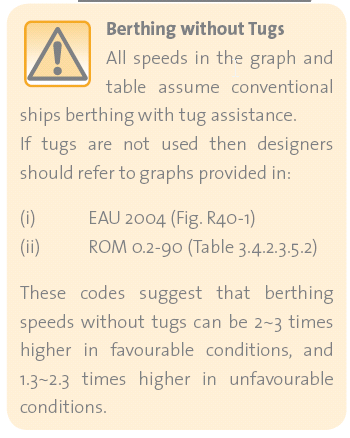
In more difficult conditions velocities may be estimated from below Figure on which five curves are given corresponding to the following navigation conditions.

a) Good berthing, sheltered;
b) Difficult berthing, sheltered;
c) Good berthing, exposed to waves and/or currents;
d) Difficult berthing, exposed to waves and/or currents;
e) Adverse berthing, exposed to waves and/or currents.

Ship size vs Berthing Speed Calculation
Picture

(2) Hydrodynamic Mass Coefficient, CM

The hydrodynamic mass coefficient allows the movement of water around the ship to be taken into account when calculating the total energy of the vessel by increasing the mass of the system. The hydrodynamic mass coefficient CM may be calculated from the following equation (BSI, 2014):

CM = 1 + 2T/B = 1.5

Where T is the draft of the vessel (m).
B is the beam of the vessel (m).

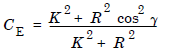
(3) Eccentricity Coefficient, CE

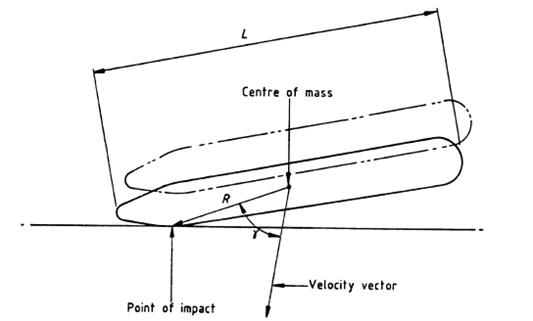
A vessel will usually berth at a certain angle and hence it turns simultaneously at the time of first impact. During this process, some of the kinetic energy of the ship is converted to turning energy and the remaining energy is transferred to the berth. The eccentricity coefficient represents the proportion of the remaining energy to the kinetic energy of the vessel at berthing. The formula for calculating the coefficient is given as follows (BSI, 2014):
Picture

Where K is the radius of gyration of the ship.
K = (0.19Cb + 0.11) L
L is the length of the hull between perpendiculars (m).
Cb is the block coefficient
Cb = displacement (kg)/(L(m) x beam(m) x draft(m) x density of water(kg/m3))
R is the distance of the point of contact from the centre of mass (m).
γ is the angle between the line joining the point of contact to the centre of mass and the velocity vector.
Picture

4) Softness Coefficient, CS

The softness coefficient allows for the portion of the impact energy that is absorbed by the ship’s hull. Little research into energy absorption by ship hulls has taken place, but it has been generally accepted that the value of CS lies between 0.9 and 1.0. For ships, which are fitted with continuous rubber fendering, CS may be taken to be 0.9. For all other vessels CS = 1.

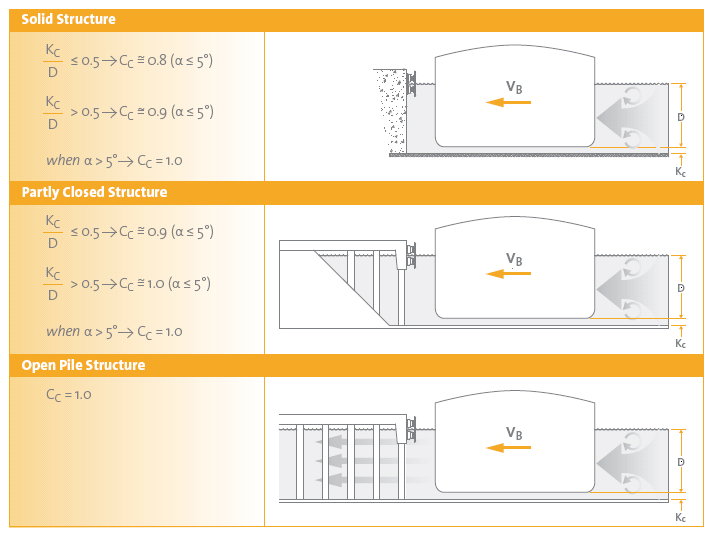
(5) Berth Configuration Coefficient / Water Cushion Effect, CC

The berth configuration coefficient allows for the portion of the ship’s energy, which is absorbed by the cushioning effect of water trapped between the ship’s hull and Wharf wall. The value Cc is between the ship’s hull and Wharf wall. The value of CC is influenced by the type of Wharf construction, and its distance from the side of the vessel, the berthing angle, the shape of the ship’s hull, and it’s under keel clearance. A value of 1.0 for CC should be used for open piled Wharf structures, and a value of Cc of between 0.8 and 1.0 is recommended for use with a solid Wharf wall.
PictureBerth Configuration Coefficient Water Cushion Effect

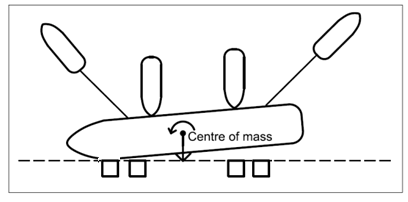
4.5.2 Berthing Energy Distribution

It shall be assumed that the first berthing fender will absorb 100% of total berthing energy.
Berthing Energy Distribution

Berthing Load Estimation

Super cone fender or other fenders shall be used to absorb berthing energy. Characteristic of fender compression and reaction force shall be used to determine compression of fenders.

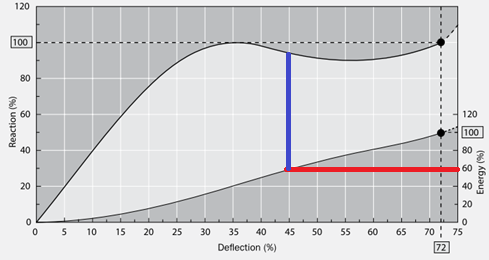
According to the calculated berthing energy, the berthing load can be extracted from the generic curve of super cone fender. In below fender characteristic graph, two curves are included. Lower curve represents percentage of maximum energy absorbed by the fender vs percentage of maximum deflection of fender. Higher curve reflects percentage of maximum reaction of fender vs percentage of maximum deflection. Assuming Berthing load absorbed by one fender, we can calculate this energy in terms of fender maximum energy absorption capacity (red line). Corresponding deflection of fender can be calculated from lower graph (Blue Line). For same percentage of deflection, corresponding reaction produced can be calculated from higher curve.
Picture
Wharf side Mooring Condition

Hydrodynamic Analysis

Diffraction Radiation calculation are performed with software. This classical problem of diffraction radiation leads to the evaluation of the hydrodynamic loads
on a structure, submitted to regular waves and enable to get accurate RAOs operation of the vessel. The effect of shallow water on drift loads is considered in the analyses and provides proper drift forces on the hull (QTF, Newman Approximation). Ship hydrodynamic model shall be used which gives resultant forces bit higher than original barge and tug boat. 30 x8x3 m barge hull is modelled with windage area of 10x76x4 This arrangement represents hull with cargo windage area or tug boat with accommodation windage area.

Time Domain Mooring Analysis

The analysis is an assessment of the loads made at the Mooring bit, fenders and the mooring lines based on a numerical model using available data. The simplified configuration of the Barge/Tug boat is modelled in Moses as per design data previously presented and based on the following assumptions

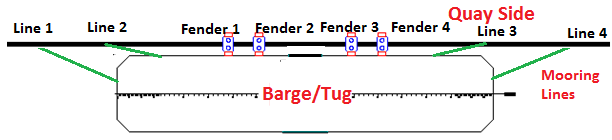
Barge/Tug boat are moored to the mooring bit using mooring ropes and resting on fenders. Barge/Tug boat is modelled with 4 mooring lines. Hull is a moving body under the action of wind wave and current. Mooring ropes are modelled as nonlinear spring. First, incidences of wind, wave and current are decided based on available metocean data. Then, time domain analyses are run for the independent wind wave and current cases for 1 hour duration to be able to decide the worst headings to study the combinations of wind wave and current.

Second, the time domain analyses for the combinations of maximum individual wind wave and current are run. The duration of the simulations are 3 hours at real time ensuring the capture of sufficient number of low frequency motions cycles.

About Maxsurf Stability

The Maxsurf Stability module provides fast, graphical, and interactive calculation of intact and damaged stability and strength for all types of Maxsurf designs. Once a design has been created using Modeler, its stability and strength characteristics can be assessed using the Stability analysis module. The Stability analysis module provides a range of powerful analysis capabilities to handle all types of stability and strength calculations.

Maxsurf Large Angle Stability Analysis of Cargo Vessel

Precise calculations are performed directly from the dynamically trimmed NURB surface model without the need for offsets, command line hydrostatic programs, or batch file preparation.

Large Angle Stability Analysis of Offshore Supply Vessel

All functions within Stability are performed using a graphical multi-window environment consistent with all other Maxsurf modules. Data is displayed simultaneously in graphical and tabular form and is automatically updated when changes are made and as the analysis progresses.

Maxsurf Barge Model Equilibrium Analysis Tank Levels of Ballasted Barge

MAXSURF Stability also provides the ability to perform multiple analyses in one step with a very simple set-up window. An Integrated Load Case Editor makes setting up any number of loading conditions simple and error free. Copying and pasting data to and from spreadsheets also makes it easy to prepare complex loading schedules in other programs and run them in Stability. Load cases can also be saved and reused with various design configurations.

Tank and Compartment Modeling are integrated within Stability, allowing you to quickly and easily define the vessel’s tank and compartment layout. More complex compartments can be defined using surfaces created in Maxsurf Modeler. Tanks are automatically included in the weight schedule and as parametric objects they are automatically updated if the hull shape is changed as the design progresses. A tank calibration option is provided to give detailed volume and CG characteristics of all tanks.

Tank Geometries Automatically Update When Hull Form Changes Are Made
Note How Tank Levels are Shown and Incorporated into Loadcase Automatically

The Maxsurf Stability module includes intact and damaged options (including Probabilistic Damage and MARPOL Oil Outflow) for a wide range of analyses including upright hydrostatics, Large Angle Stability, Equilibrium Analysis, Floodable Length, KN tables (Cross Curves), Limiting KG, and Longitudinal Strength analysis. For each analysis method, Stability automatically highlights the required data to be entered and provides data entry dialogs to ensure data is entered correctly.

Damage Stability Analysis of OSV

Maxsurf Stability provides a wide range of Stability Criteria, including the most commonly used standard criteria, that can be used to ensure compliance with class requirements. The software also allows you to define your own custom criteria for special requirements. When used in conjunction with the table of downflooding points, it provides a complete range of options for satisfying class.

Built-In Maxsurf Stability Criteria

After an analysis is completed, all results are presented in either tabular or graphical form. We can click on any graph and move the cursor to obtain precise values at any location. We can also choose how tables are displayed, which columns are visible, and sort results by any column.

Sample of Large Angle Stability Analysis of Catamaran

An automatically formatted on-screen report window accumulates the results of analysis to help prepare a stability book for your vessel. Descriptions, tables, graphics, and graphs are automatically inserted and can be re-formatted or deleted at any time. You can also enter notes into the report and cut and paste graphics from the Stability module, other Maxsurf modules, or any other program. The entire report can be generated using a Microsoft Word template.

Maxsurf Longitudinal Strength Analysis

The wide range of analysis, data entry, and data display options within Maxsurf Stability make it an indispensable tool for designers of all types of vessels. For designers with a limited budget, the basic Stability module contains only the intact hydrostatics and large angle stability analysis methods. Stability features included in the Maxsurf Advanced Suite adds tank definitions and calibration, stability criteria, damage stability, longitudinal strength, limiting KG, floodable length, and MARPOL Oil Outflow, while Stability features included with the MAXSURF Enterprise Suite adds Probabilistic Damage Stability.

Modeling Bridge

Segmental bridge template and wizard using CSIBridge for quick definition of spans and segments as well as tendon layout.

Segment labeling scheme
Span-by-span segment definition
Cantilever tendon definition and layout
Tendon anchors and ducts layout

New solid concrete girder deck section.

Concrete solid girder deck section definition

Nonprismatic variation of concrete U-girder sections.

Nonprismatic U-girder bridge with cutaway to show horizontal bracing

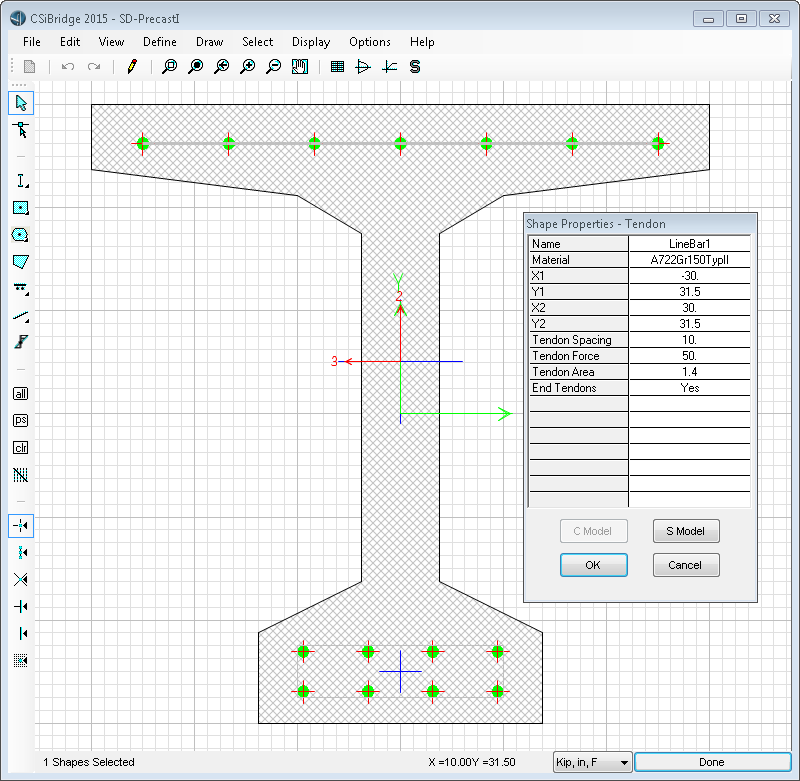
Section designer now allows prestress tendons to be defined for any concrete sections.

Concrete section with prestress tendons.

Standard vehicles are now defined in XML libraries, allowing users to create their own custom libraries.

HL-93S vehicle from the AASHTO vehicle library

Standard precast concreate I, U, and bulb-tee girders are now defined in XML libraries, allowing users to create their own custom libraries.

Caltrans CA TUB73 precast-U girder from the Caltrans frame section library

Analysis

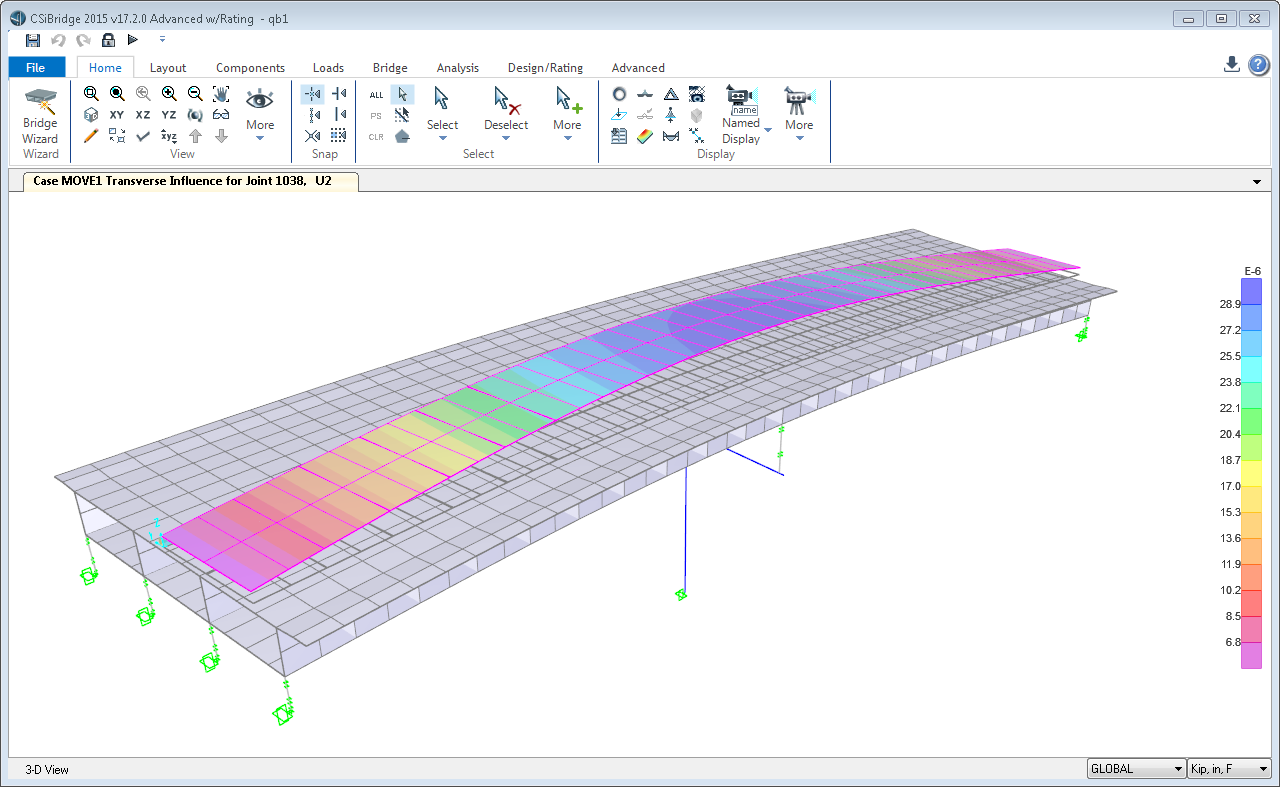
Horizontal influence-based moving loads for braking/acceleration and centrifugal

Influence surface for transverse moving load and wheel reactions due to centrifugal force.
Modeling Truck on the Road
Vehicle horizontal loading definition

Design

Superstructure design according to AASHTO LRFD 2014 (7th Edition), including the 2015 interim revisions.

Superstructure design preferences showing supported design codes

Superstructure rating 2014 and 2015 interim revisions according to AASHTO.

Rating preferences showing supported interim revisions to AASHTO Rating 2010

Output and Display

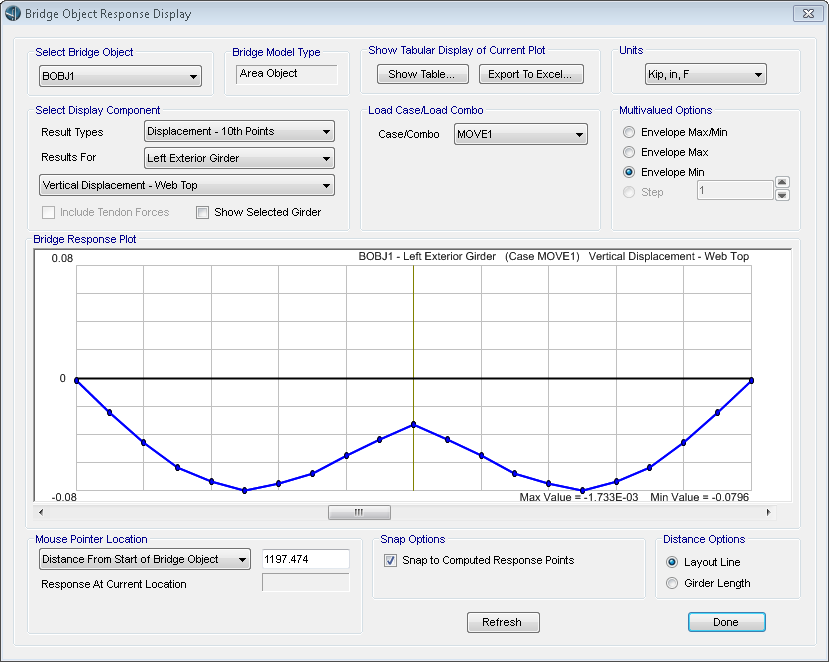
Superstructure displacements for the entire section along the layout line and for individual girders or webs along their individual lines.

Girder response plot showing 10th point displacements

Scale factors are now available for time-dependent creep, shrinkage, and stiffness of concrete, as well as relaxation of tendons.

Concrete material time dependent properties

Featured

Offering Services

The movement of super-heavy cargo items is challenging and requires intensive collaboration between clients, suppliers and Califilard Consulting’s technical, engineering and operational divisions. At Califilard Consulting, clients get everything in-house. Our heavy lift and technical team is an industry leader in transportation of over dimensional, abnormal and heavy lift cargoes. Skilled heavy lift experts and naval architects design, implement, manage and survey tailor-made handling methods, transportation arrangements and shipping concepts both from their home offices and in the field.

Transport surveys and feasibility studies

To mitigate project risks it is essential to have reliable data available on existing transport restrictions and constraints as early as possible. We will assist you in the evaluation of these risks by conducting transport route surveys and feasibility studies. This consideration is paramount in order to compile a correct budget, to be on schedule, and preventing damages.

Lifting studies

Lifting requires the inclusion of detailed lifting studies during the course of the design of the product. We will support you to manage the interface between the product supplier and the lifting operator.

Complete door-to-door planning

With an in depth knowledge of all aspects of the heavy lift transport business, we can provide you with independent expertise to deliver your product safely and on time to destination. Our ambition is to offer you the best support to develop the best transport concept on basis door-to-door.

Planning and execution of installation

We offer a complete solution from lifting design to the planning and delivery of the product to final destination, including the lifting operations and supervision.

Risk Assessments and Method Statements

Environmental protection and safety at work are considered an important factor, today. Unknown risks are the ones that scare the most either from a commercial point of view and/or from a legal aspect. We from Califilard Engineering Consulting help you to identify and understand these risks during transport and lifting operations and will assist you to prevent incidents or accidents.

Packing engineering for industrial goods

Califilard Engineering Consultant believes that the best preservation and packing method is conditioned by the type of product and from transport methods used during its voyage to final destination. We at Califilard Engineering Consultant are experienced in industrial preservation and packing and can assist you in developing the most accurate packing for your valuable product to optimize your total cost.

Featured

The Journey Begins

Califilard Engineering Consulting is an independent engineering company offering professional services for all aspects in the field of multimodal logistics for all types of heavy and over-dimensional components, as well as packing engineering. We can offer you a support already in the product design to guarantee the transportability of your goods from production place up to the final destination. This can be a problem solution in the transportation chain or as a “single point of contact” for a complete solution.

IMG-20180310-WA0004

Califilard Engineering Consulting puts the client demands in the center. Each project is unique and we provide qualified solutions to your challenges and requirements.

Custom-designed to handle heavy and oversized components

Transportation of heavy- and over dimensional components may have a number of unpredictable impacts on your budget and schedule if not meticulously planned from the very beginning. Depending on local regulations and condition extensive adjustments on existing infrastructure may be necessary and imposed. This, as a “last minute pop up”, may expose your spends in fulfilling your contractual obligations. Califilard Engineering Consulting assists you to minimize these risks.

IMG-20151210-WA0005

Benefits

Depending on your project, installation may be a point to be considered already in your civil planning. We, at Califilard Engineering Consulting are convinced that the best time to consider heavy lift installation planning has to begin in the start-up phase of the project. Concept studies may prevent you from costly changes and delays. We provide you with best solutions to minimize your cost-, damage and schedule exposures.